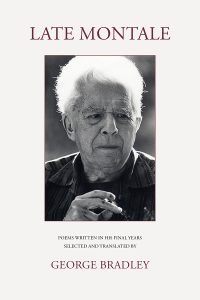
George Bradley, A Few of Her Secrets


70 pp, ISBN: 978-1-904130-420, £8.99 (paperback only),  
Publication, February 10th 2011


Post-free for on-line credit/debit card orderrs


I wish to order this book


A note about A Few of Her Secrets

A Few of Her Secrets is George Bradley's first collection of poems in ten years, and Bradley's many admirers will be sure to think that it was well worth the wait. The collection's high-spirited and adroit poems aim to entertain in the best sense of the word, and they range widely in subject and tone. The book includes amused and occasionally caustic observations regarding America's "culture wars"; enthusiastic and witty renderings of Italian food recipes; and heartfelt yet unsentimental meditations occasioned by the deaths of relatives. As poet and critic Eric Ormsby puts it (see below), "Each of this poet’s previous collections has been an event. A Few of Her Secrets may be his finest achievement yet."


A note on George Bradley

George Bradley was born in Roslyn, New York, in 1953 and was educated at Yale University and the University of Virginia. Among the awards his work has received are the Witter Bynner Prize from the American Academy and Institute of Arts and Letters, a grant from the National Endowment for the Humanities, and the Yale Younger Poets Prize (1985, judge James Merrill). He is the author of four previous collections of verse – Terms to Be Met (1986), Of the Knowledge of Good and Evil (1991), The Fire Fetched Down (1996), and Some Assembly Required (2001) – and was editor of The Yale Younger Poets Anthology (1998). Besides writing books, Bradley has been occupied in many ways – as a construction worker (installing foam insulation), as a copy-writer (on staff at several small advertising companies in New York City), as a sommelier (at The American Hotel in Sag Harbor, Long Island, a restaurant with 650 wines on the list, 15,000 bottles in the cellar, and vintages going back to the 1800s), and as an editor (cleaning up translations from the Japanese for the Jack Tilton art gallery). Like most poets, he has also taught creative writing on occasion. Currently he imports and distributes La Bontà di Fiesole, a brand of olive oil made from the seven hundred trees on a family farm outside Florence and described by him as “the elixir of life.” When not on the farm, Bradley lives in Chester, Connecticut.


Praise for A Few of Her Secrets


“The poems in George Bradley’s brilliant new collection have conspiratorial accents; we find ourselves drawn into unsettling confidences, disclosures at once playful and appalling. These are poems of great formal mastery and of elegant wit and yet the artistry is suavely unobtrusive; Bradley is a practitioner of that ‘piercing virtue’ which Emily Dickinson, another connoisseur of renunciation, extolled. His engagement with our popular culture is one of exasperated affection but he views our fads, our pastimes, our patterns of speech from the perspective of antiquity; he’s an American poet with what might be called a Roman cast of mind – reflected not only in his profoundly Virgilian sense of ‘a mortal rapture in all things’ but in seven poems of mouth-watering Italian recipes. The collection begins just outside the gates of Eden, guarded by ‘gladiate fire,’ and extends into an uneasy future. There is the best poem yet written on 9/11, ‘Advisory,’ a set of variations on September with its heartbreaking ‘baby blue’ sky. There are gnomic utterances, sudden aphorisms, ecstatic phrases that, as he suggests, ‘exfoliate the callus that facilitates evasion.’ Bradley is a learned poet; he deploys echoes of Milton and Auden and Christopher Smart, as well as the Bible, but does so with such wry panache that the allusions are continually refreshed. Each of this poet’s previous collections has been an event. A Few of Her Secrets may be his finest achievement yet. It is a rare pleasure in these unpropitious times to witness a poet exulting in all the registers of the language and having such enormous delight in his art.” – Eric Ormsby


Praise for Bradley's earlier collections


“George Bradley's The Fire Fetched Down earns its Promethean title, and helps persuade me that American poetry will go on maintaining itself as a high art even now and in worse days to come, when politicized bad verse (when it is even verse) is celebrated in the academies and in the media. Bradley, now fully individuated, has the cognitive power, the rhetorical gifts, the primal exuberance of language, and the spiritual vision, to develop into the Merrill or Ashbery of his own generation. Everything in The Fire Fetched Down will sustain, and reward, many readings." – Harold Bloom


"Bradley is an increasingly impressive poet whose meditative modes have sharpened edges, and whose command of form and diction is truly authoritative. In this admirable book [Some Assembly Required], the lovely sonnets of 'A Year in New England,' and the kinds of satiure variously deployed in 'A Poet in the Kitchen,' 'Apologia,' the title poem, and the long, splendid 'How I Got in the Business,' clearly reveal this poet's range and seriousness." – John Hollander


"Some Assembly Required is a book of wonders, a laudable accomplishment in a variety of modes and means. Most of these poems are bravura acts of high spirits, of an agile, daredevil mind and a rich and happy cocabulary. Now and again we encounter veiled allegories, misty and dense in their suggestions, and we discover the dark entrances to the catacombs of dreams. But George Bradley's assurance and command are always in evidence, and his achievement is delightful throughout." – Anthony Hecht


"A common strategy for sorting American poets after World War II has been deciding whether they fall in the Wallace Stevens or the William Carlos Williams camp; that is, whether they are formal or colloquial, ornate or plain, allusive or straightforward, witty or humorous, and on one or the other side of similar antinomies. If his well-turned verses, penchant for obscure words, and general sophistication place Bradley in Stevens' bailiwick, choosing to write about his rather ordinary past and present tilts him toward Williams'. The triplets of "Walking Philosophy" richly, densely meld physical images and processes of thought, a la Stevens, but the images are downright folksy--swinging in a tree, feet dangling; messing in the yard; out walking, aimlessly--as they lead to a witty, word-playing conclusion. Hmmm. Come to think of it, the third major American modernist progenitor, Robert Frost, characteristically partakes of both alternatives in those pairings that distinguish Stevens from Williams. Bradley isn't as shrewd as Frost but is as balanced, neither too exquisite nor too commonplace, so that the long poem "How I Got in the Business" sustains its comparison of poetry and olive-oil production with unflagging humor, grace, lusciousness, and even poignancy. The calendar of sonnets, "A Year in New England," isn't a whit less adroit and affecting. Ditto, the rest of a sterling collection." Ray Olson


From A Few of Her Secrets


Advisory

for Jim Kehoe


          September’s lovely in New York, the sky
          Returned to baby blue, the breeze now mild
          As breath, and if you’ve anything at all
          Important planned, now’s when to do it: fall
          In love, begin a book, beget a child,
          Marry, get religion, learn to fly.

          September’s stunning, even on so odd
          An island as Manhattan, of all places
          Least like landscape: climate cannot bungle
          This month without a more than urban jungle,
          Without an icecap, or those desert spaces
          Composed of dust and emptiness and God.

          September’s drop-dead gorgeous or it’s plain
          Disaster here, airborne catastrophe,
          Some sub-tropical depression, say,
          Originating half a world away
          And gaining, as it moves across the sea,
          The turbine fury of a hurricane.

          Still, September’s dangerous days are few,
          Whirlwinds tracked worldwide. You can assume
          Responsible officials will foresee
          Such turmoil; you can count on your TV
          For early warning. There are those for whom
          This hasn’t worked, but it should work for you.

          I know a man who paused to say goodbye
          With care to those he loved one morning, fold
          Them in his arms, and just that slight delay
          Spared him on a bright September day
          When air turned ash, the center could not hold,
          The quickly dead fell burning from the sky.


          © George Bradley, 2011


Based on a True Story


          No, not equal to, not ever, for all
          it couples in public vehicles and crawls
          through sewers as through astonishing bars
          of light, of music, but rather a bizarre
          bazaar of retailed wisdom and aperçu
          happily assembled out of what you
          will, so that it variously contains
          a woman, a bed, wind and rain,
          heaven and hell, a mouse’s nest,
          a winter’s midnight dressed
          in radiant bolts of shimmer shots,
          its construct ad hoc on its base yet not
          the thing itself, being for better and worse
          a derivation, a version and perverse.
          Put much in and most is left
          over, the sprawled magnitude of evasion deft.
          Leave everything out and some trace
          inheres in what sparse space
          affords. Pare it down, puff
          it up, it cannot be pruned or plumped enough
          to be coterminous with its occasion, but must extend
          elsewhere, more rational and pointed, to an end
          and to our eyes
          more moving. More shapely. More concise.


          © George Bradley, 2011


Home PagePoetryOrderingNewsCredits
The PressFictionTradeEventsLinks
Contact UsNon-FictionRightsMailing ListVacancies
ImprintsIllustratedPermissionsSubmissionsSearch

The Anthony Hecht Poetry Prize