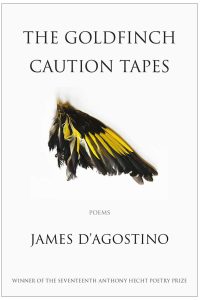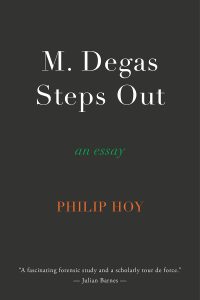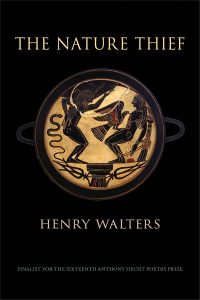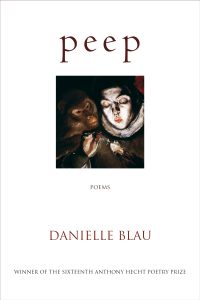
The Anthony Hecht Poetry Prize

2005


Two poems from Lisa Williams's Hollow

followed by a note on the author


The Iceberg

The iceberg moves will-less
through shades of gray and gray,
a tower of clouded glass

seeming proud ofisolation, rising
in air. Or the iceberg's top lies
flat along the water, its misshapen

turrets jutting below the surface
like an upside down, gothic cathedral
made of ice.

Around the tower and its moat
or the inverted iceberg, or tipped cathedral
dipped in the green-black liquid and remote

in mists (if you could stand in the middle
of it all) is the smell of ice and brine,
rough sea in the purist wind

that blows from far-off coasts
and stays here, freshening.
You would taste a tinge of time

on your tongue, its encrystalled distances
jagged in the strong dark absence of lament –

that chunk of knowledge always inaccessible

but always defended by the physical
world, without judgement or pretense,
simply floating.


On Not Using the Word "Cunt" in a Poem


Certainly there's pressure to perform
in such a way what doesn't sound so stately
and isn't safe: Let it be shorn,

the poem's lush holiness
. Let locks be trimmed.
Cut to the chase. How unchaste can you be?
Can I proffer a different kind of tongue,

one that licks nether regions? Can I start
offering words that aren't courtly or cute
and don't contain such blanket recanting,

of words I use when I am in a wreck
or made at somebody or being fucked
– those anti-canticles I chant when hurt,

the kind of words I punt when breaking glass
or bumping ceilings? Can I be curt,
not hunt for language so gosh-darned appealing

but pick what's more intransigent
and less ornate? Or is that just a judgment
ignorance can make – that stealing

the spotlight, showing one can "rough it up"
is really more mere decorativeness,
like the performance of a burlesque romp

by someone who would rather keep her dress?
Is that all poems can do to snatch attention,
use such dim tents of tricks? Let's nick

this baby in the bud: am I too mendicant
to fluid cadence? Do I serve lip
by thinking a poem is holy, not a hole

to thrust things in, for the very sake of thrusting?
Or do I suit myself for an audience
by shirking my naked voice, or the cliche

of what a woman's naked utterance
would be, as if just honest women cussed?
Should I be someone who docks elegance

because it's penal territory,
someone who takes the name of poetry
in vain – who kicks the ass of beauty?

I know we're all voyeurs, but can't
you come for me a different way this time
and listen, for one minute, to a poem

that's not revealing crotch and pay attention?
Is it impossible for me to strut
my stuff without the madonna/whore

dichotomy? Without the flash of tit-
illation, would you give my poem a date?
Or must I count my kind of cunning out?


©


Lisa Williams was born in Nashville, Tennessee in 1966, and was educated at Belmont University, the University of Cincinnati and the University of Virginia, where she obtained her BA, MA and MFA, respectively. She is currently Assistant Professor of English at Centre College. Lisa has one previous collection of poems, The Hammered Dulcimer (Utah State University Press, 1998), which was selected by John Hollander for the May Swanson Poetry Award, and her poems have appeared or are forthcoming in a wide variety of journals, amongst them Southern Review, Raritan, Southwest Review, Literary Imagination, The New Republic, Bat City Review, Quadrant (Australia), Virginia Quarterly Review, Poetry, Image, and New England Review. Apart from the May Swenson Award mentioned above, Lisa's honours include the Rome Prize in Literature awarded by the American Academy of Arts and Letters (2004-2005), a recent nomination for a Pushcart Prize by editors of Southwest Review, Southwest Review's Elizabeth Matchett Stover Award (for best poem published in its pages) (2002), a Walter E. Dakin Fellowship (1998) a Tennessee Williams Scholarship from the Sewanee Writers' Conference (1997), a Henry Hoynes Poetry Fellowship, from the University of Virginia and an Elliston Poetry Fellowship from the University of Cincinnati.

"The Iceberg" first appeared in Southwest Review (winning the Elizabeth Matchett Stover Award as the best poem published in that magazine in 2002), and "On Not Using the Word 'Cunt' in a Poem" first appeared in Virginia Quarterly Review.


Home Page Poetry Ordering News Credits
The Press Fiction Trade Events Links
Contact Us Non-Fiction Rights Mailing List Vacancies
Imprints Illustrated Permissions Submissions Search

The Anthony Hecht Poetry Prize