
Uncategorized
Nicole Caruso Garcia
Two poems from Nicole Caruso Garcia’s Oxblood
followed by a note on the author
Capacity
I sometimes wonder if I’m just a ghost:
When I’m alone, unbuttoning a cuff.
When daubing perfume on each perfect wrist.
When folding garments, each a hollow self.
A suicide: a box on patient intake
forms, a footnote to a headstone, stiff
and imprecise, an ill-fitting sack.
I run my lips across my wrists (kiss, kiss)
for proof I live. And if they’re not a trick,
a mockery, then I must confess
the love and decades I might not have had.
I tremble for a truer name for this,
this having risen from the neverdead.
I am whole, yet hyperventilate—
I am a could-have-cut, a would-have-bled.
I’ve housed the breath before you consummate
the carpe mortem, glittering with intent.
Resolve that sober can intoxicate.
Prostrate, I’d given angels my consent.
I’d chosen my finest dress, a lacy sheath,
as if to bandage sin in sacrament.
We label mostly in the aftermath.
We can’t quite throat a word that could contain
the moment that the apple felt Eve’s breath.
Some membrane torn already in my brain,
what hand had held me here against my will?
An object set in motion stays in motion.
The only word for that is miracle.
That, too, becomes a thing that you survive.
It changes you, the knowledge you would kill,
to occupy the hour at such an octave,
prayer so pure you’d call it blasphemous.
What simple word could show you where I live?
The whole transcends the parts I name with ease.
(The knife was aptly named: utility.)
I need a word to hold all this because
I did not fail; my name means victory.
And there’s a word for what he did to me.
Nicole Caruso Garcia
I Never Fell in Love with You
To fall in love implies a lack of choice,
As if I were cartoonish, maladroit—
And love, an open manhole to avoid.
To fall suggests a kind of loftiness,
That I began in some exalted place
And not the aerie of my loneliness.
To fall like rain, or tears, or mercury,
A pawn of Cupid or of gravity.
No. With my grappling hook, I climbed precisely.
To fall—kerplunk—is stumbling, imperfection.
No, I would brave the hot tar of rejection
To wear the ermine cloak of your affection.
I built a trebuchet and aimed to sail
Beyond your moat, over your castle wall.
I launched, I soared in love; I did not fall.
Nicole Caruso Garcia
Capacity
first appeared in Antiphon; I Never Fell in Love with You
first appeared in The Rotary Dial.
Nicole Caruso Garcia is an American poet and educator. Born in 1972 in New Jersey, she was raised there and in Connecticut where she now resides. Educated at Fairfield University, she holds a B.A. in English and Religious Studies. After seven years in the corporate sector, she earned her M.S. in Education from the University of Bridgeport and taught English at Trumbull High School for 15 years. Garcia serves as Assistant Poetry Editor at Able Muse and a Board member at Poetry by the Sea: A Global Conference. A past winner of the Willow Review Award, her poems have appeared in Crab Orchard Review, DIAGRAM, Measure, Mezzo Cammin, PANK, Plume, The Raintown Review, Rattle, RHINO, Tupelo Quarterly, and elsewhere. Visit her at www.nicolecarusogarcia.com
.
James Davis
Two poems from James Davis’s Club Q
followed by a note on the author
The Human Situation
Wednesday
I wake with the same erection I had during liftoff.
Cabin pressure, recycled air, a rhythmic, uterine rush.
My carry-on’s fat with Classics. My tray table buckles
under the Metamorphoses, page marked with boarding pass.
I’ve checked the Republic and stowed St. Augustine. I pray
for delayed landing and nurse a cran-apple cocktail.
The four-ounce plastic tumbler won’t stop sweating.
Below, the stark geometry of America’s midsection:
vast circular fields irrigated by a central pivot compass
and sliced into perfect sixths. Reddi-wip contrails.
Cauliflower cumulonimbi. Our shadow grazes the earth,
compartment by logical compartment, until it’s swallowed
by a larger shadow. Minor turbulence. A man tears a slit
into his package of nuts and empties it into his mouth.
Thursday
My sister and her husband have just returned from Istanbul.
She’s wearing a sequined hijab. His English is spotty.
The turkey, as always, is far too large. We pray over it.
Before dessert, my father produces a Porky Pig cookie jar
filled with legal pad scraps, a Bible verse handwritten on each.
We all draw our scrap, unfold it, read it aloud. Dad explains
what each one makes him thankful for. The little things.
Once the carcass fits into the refrigerator, we break out
Taboo, the Game of Unspeakable Fun.
If I want my team to guess sister,
I cannot say apostate.
If I want my team to guess love,
I cannot say cock,
lube,
fabulous,
lavender,
roommate,
or buddy.
The parents look over the children’s shoulders. Vice versa.
I hold the buzzer’s pink button until I’m told to stop.
Sunday
All flights canceled. On the news, a meager death toll:
three for the whole blizzard, all at the same time,
a mother and two sons retrieving supplies. Black ice.
Five-foot drift. The heat left on full blast
in their silver Escape. As usual, carbon monoxide,
the children first. California plates,
the locals cluck and switch back to the game.
I’ve warmed up to my old room’s tacked-up playbills,
the Mondrian imitation waffling over the headboard.
My professor has granted my request for an extension.
I remove a ceiling panel and browse my library: Freshmen,
Unzipped, a yellowing catalog (Abercrombie and Fitch).
Inside my senior yearbook, I’m told you’re going
places! Have a great summer! Never forget who you are!
James Davis
White Chickens
Yeah right, replies so much. I depend upon myself, not your wheel, nor your polite chickens.
My love got lost at the Mineral Show and fell in with a flock of malachite chickens.
Even my grandmother has an iPhone. She texts rarely, hunting for the emoji juste.
Her daughter moved to a red state, bought a tractor, shoots coyotes who try to bite chickens.
So much depends upon history or, more broadly, Social Studies. My high-school rain dance
conjured only a happenstance of glitter and rare, collectible Rainbow Brite chickens.
Everyone’s crazy about protein these days. Every salad is a green meat-vehicle.
All these beautiful men at the gym strut like hypertrophied, hey-you-wanna-fight chickens.
Tonight’s special is served with a demi-glace of esoterica and simple syrup.
Oh, hi. I’m James, but you can call me So Much. See you at the White Party. Invite chickens.
James Davis
James Phillip Davis was born on a U.S. Army base in Nuremburg, Germany, in 1985 and grew up in Colorado Springs, CO. He has a BA in French from the University of Houston and an MFA in Creative Writing from the University of Florida. He has worked in marketing and instructional design for a major restaurant chain and as a high school speech-and-debate coach. His poems have appeared in two installments of the Best New Poets anthology (2011 & 2019), as well as numerous print and online journals, including American Literary Review, Copper Nickel, The Gay & Lesbian Review, and 32 Poems. When not writing, he plays tournament Scrabble and is consistently ranked among the top 100 players in North America.
Mirande Bissell
Two poems from Mirande Bissell’s Stalin at the Opera
followed by a note on the author
About the Screenplay
They’ve buried a dead girl under the story again
like a fish head in a tomato garden—
to tap her mineral veins and blue breath.
There’d be no story, the writers tell anyone
who’ll listen as they ride the elevators up
and down, if someone flute-boned hadn’t
bled out, if the downy animal we’ve come from
weren’t nested under the foundation.
They’re waiting for what will grow
from her punctured windpipe, her water-
logged skin. Though the girl isn’t dead
at all. She’s waiting for the desert
at night. For interstellar cool. She’s
a bird of prey looping over their city
and the small lizard evading her own gaze.
Mirande Bissell
Pony Credo
My father asked for an end to labor,
but over and over the world was laid
like a newborn in his arms. He rescued
the black pony from the dog food buyer
at auction, though rescue is too strong
a word. With his bum leg, the pony lived
with us five years, fathering
two unexpected foals my brother and I
discovered, silver on their spindle-legs
in grass high as our chests, the placenta
steaming at our feet. We ran to tell
the grownups, past the neutered goat
we’d all mistaken for a nanny,
past cats dropped off in the night,
sleeping in car engines cold mornings,
till the engines turned over.
The pony collapsed on the ice
one morning, his eyes rolled back,
his muzzle locked with tetanus.
I haven’t been waiting for anything
but his seized throat to open,
his easy breath on my palm.
I believe there’ll always be
foxes more lithe
than I’ll ever be, their forgiving tails
waving along blond crests of hills.
Resurrection is clover. Abundant,
a nuisance even.
Mirande Bissell
Mirande Bissell lives in Ellicott City, Maryland. She is a recent graduate of the Bennington College MFA in poetry program. You can find her poems in journals such as Meridian, Bellingham Review, and Chattahoochee Review, among many others. Her poem “The Mammoth Steppe” won the 2019 prize in the Stone River Poetry Review contest.
About the Screenplay
was first published in Mississippi Review, where it was a 2019 prize finalist; Pony Credo
was published in Little Patuxent Review.
Ethan Stebbins
Two poems from Ethan Stebbins’s Talking to You
followed by a note on the author
Poem for Mandy
The sky hangs like dented metal.
Like a gray pan
beat in solidarity
with the party faithful
of vastly conflicting forms
of disagreement.
I am wearing my safety-orange earplugs.
I am identifying with
and resisting the impulse
to wake the screen
and watch the child
in the body of a man
in the costume of commander
of everybody
work his mouth into an ass
made famous for its violent
and hazardous flatulence.
I hate that thing in me
I hate in him
that always covets
the dove-colored plumes
left by a rocket
leaving Earth
with his flaming head
on a ballistic mission
into nonexistence.
Citizens of my heart!
inside each of you
parades a vain retarded bull
you will either learn to pity
or threaten to become.
Schadenfreude
is a big word
I never remember.
When you google
schadenfreude
an image of a painting
by the 19th century Spanish painter
Eduardo Zamacois y Zambala
out of thousands of lucent pixels
instantaneously appears.
The painting
is “Return to the Convent.”
Note the group of monks laughing
while the lone monk struggles
with the donkey.
Like a very large egg
in the mouth of a very small snake
it makes me capable
of holding in my mind
a fragile orb
of real empathic sadness.
When S. left she left
a mini shampoo in the shower,
like the hospitality industry offers,
because I had none,
and because she is kind,
which destroyed me
in a new and specific way.
Somewhere now forever
our future sulks
like the strange and to us
totally perfect daughter
we never had.
It’s complicated
how much I can’t understand
the love this child
in me engenders.
I feel sure her name is Mandy.
In Mandy I see in me
my great talent for suffering.
I see the emptiness we’re up against.
I want to be there
during this crucial time
of her budding disenchantment.
I want to catch her and protect her,
and be a shepherd of Mandy,
but she’s never not escaping.
She floats out
like a beatific moth
in an experimental wind
monitored by a team
of all male albino vultures.
The team nods.
The team is hopeful.
To see her fail
would confirm a belief
they’ve already decided
they think they know is true.
Ethan Stebbins
Dear Sarah Huckabee Sanders
Your hair is beautiful today.
In an opera that is often
violent and bewildering
your hair precedes you
like a familiar friend
signifying something deliberate
and uninspired is about to happen.
Your hair is always the same.
Your hair is the same
as my sister’s when I was 6
and she was 8 and was by me
unjustly tortured. Daily
into the blue room you march.
Daily the bland discursive crows
attack your face. Your hair
is a helmet made of silk, a brown tarp
protecting a white balloon.
Sarah you are not my sister.
In this memory I’m having
my father who is not Mike Huckabee
is brushing my sister’s hair
the color of mud and certain horses.
We are watching our parents
watch the news. Our clothes
the couch the television
everything indicates the end
of a Reagan-era we’re too young
to understand. Every night
he brushes her hair
and every night the head
of someone named Oliver North
fills the screen for longer
than seems fair. The head
looks damp and cold, like something
packed from wet clay.
I think it’s the boringest head
I’ve ever seen. Later in bed
when I close my eyes
the gray clay head
is burned into my brain.
It floats in the dark like a dead star.
Like an anti-dad it tells me
it will not protect me. That
things will not be ok.
People are full of venom and snark.
The world is going to ask you
many difficult questions
it’s important you learn
how not to answer.
Ethan Stebbins
Ethan Stebbins is a poet and stonemason from Maine. His work has appeared in Poetry, The Hudson Review, FOLDER, The Cafe Review, Best New Poets 2008 and other publications. In 2007 he received a New York Times Fellowship in poetry from New York University, where he got a M.A. in English and American Literature. He is at work on a first book of poems.
Danielle Blau
Two poems from Danielle Blau’s peep
followed by a note on the author
The Vernal Equinox Story
Are we not drawn onward, we few, drawn onward to new era
— a palindrome
On the twentieth of March, day and night hung
in the balance, and we would
chant our palindromes — Redder. Peep. Noon. Oh, who was it I
saw. Oh, who — would fold into ash
tree shadows till cloven
sky quivered, aswarm
and Light spake again:
Behold, my forms.
Then came a reckoning
for the faint
of temper, faint of hue, as sun’s coiled
ribs exhaled sharp
Spring — downlusted blind
translucence towards us:
who clutched
the bony dusk
cast by bent sumac twigs — we few —
for splendid pestilence,
sad match, we charred
and lumpish dust;
who hallowed the stalk, begetter
of shade; who picked
our firstborns’ names from the thousand
words for gray; who hymned to
without form and void, O void and
formless void:
while all around, the spindle-
bushes — Winter’s muted saints — were drawn by blushed enormity
to brink of savage bloom: as there
beneath, the crouched
in prayer — the blasted, the dazzleworn —
scorched wheat in wind were our skirling limbs,
who sing: Yes it’s us,
Behold, our forms.
Danielle Blau
Excerpts from The Fear
No but what was I saying again
about that Thai restaurant we all
used to love? So there I
was and dead
of November by the way and I was having the Mighty
Khan Stir Fry, and Frieda ordered — I can’t
remember — but we were
talking about what
had happened and she was like No
way in hell, because — so you guys know
who Vladimir Petru is? Oh. Well anyway,
well actually never mind.
*
But there’s another me
inside of me
and she is wearing Hedi Slimane. Wait —
how? Does she have
rich parents? No clue.
See? There’s
a lot about me
we don’t know. It’s like I’ve read
about what makes
for best quality living-
room furniture: you cannot tell
by outward
look of the upholstery alone,
which, case in point, you
know, the me
inside, she truly
might surprise you: her skirt is short
like really
short and sorry
not so
age appropriate. Fuck. Don’t look now but
look: the poor thing, I think
she thinks she’s
working it. She’s like — Oops, is
my epidermis
trending? Christ. People like that
scare me. To each
his own, I mean, but personally
I’m more the down-
home type, I guess. Me, I’ll just go in this
fyi, borrowed
likeness of shrunk death.
*
Yesterday I ate yuzu fruit and spat
the seeds across the room from
where I sat in the chair. It wasn’t
the worst. I meant
to get clementines. I count all my
seeds after dark. My chair is a Casket.
No,
it’s a Gasket. A Gasca. It’s the White
Grub-Suckling Chaise by Jesùs Gasca.
*
I saw my face once
after sundown
in a hole in the sidewalk that
had filled all the way
up with rain. Inside my face
was a hole the color of
fall sky after a storm, and inside
the hole was a glow-in-the-
dark red sign
with some white
that said KFC. Gross. It’s —
just think about it. I mean, it
isn’t even real.
Danielle Blau
Danielle Blau’s Rhyme or Reason: Poets, Philosophers, and the Problem of Being Here Now is forthcoming from W.W. Norton. Her chapbook mere eye was selected for a Poetry Society of America Chapbook Award and published in 2013 with an introduction by D.A. Powell, and her poems won first place in the 2015 multi-genre Narrative 30 Below Contest. Poetry, short stories, articles, and interviews by Blau can be found in The Atlantic online, The Baffler, The Harvard Review, The Literary Review, Narrative Magazine, The New Yorker‘s book blog, The Paris Review, Ploughshares, Plume Poetry, The Saint Ann’s Review, The Wolf, the Argos Books poetry anthology Why I Am Not a Painter, several volumes of the Plume Anthology of Poetry, and elsewhere. A graduate of Brown University with an honors degree in philosophy, and of NYU with an MFA in poetry, she curates and hosts the monthly Gavagai Music + Reading Series in Brooklyn, teaches at Hunter College in Manhattan, and lives in Queens. You can learn more about her at danielleblau.com.
“The Fear” was first published – and published in full — in the Fall 2015/Winter 2016 issue of The Saint Ann’s Review.
Brian Culhane
Two poems from Brian Culhane’s Remembering Lethe
followed by a note on the author
Tolstoyan
This time of year, I always think of winters
Met in Russian novels, the snows on the river
Crossed by a bridge of prose, and someone
Waiting on the far side whose breath spirals
Up into the heavens, whose body leans over
An iron railing, whose spirit is as radiant as ice;
And I am reminded of those long afternoons
Wholly absorbed by aristocratic intrigue—
With carriages and dress balls and mothers
Standing in the wings; how in bemusement
I lovingly partook of my favorites’ vexations,
Warming my hands by the fire of their passions.
So I passed the bitter evenings of my youth,
Lost in a world lost to me and to the world.
Brian Culhane
A Large Fine River God Almost Intact
Five centuries back, from a pit in Rome,
A large fine river god was slowly raised
Almost intact, but for the beard’s clipped stone.
A crowd wondered how time’s arrow had grazed
Just that bit, leaving the lithe limbs alone
(One arm coiled to throw a spear), amazed
War and flood dislocated hair, not bone,
And left a slivered fault on which men gazed.
Then Michelangelo said Bring me clay!
And promptly showed how the beard had been worn
Knotted in front.
No master’s touch today.
What have I dredged from the marl? From mind torn,
Nude and broken? It is myself I find—
My sunlit flaw a hairline crack in rhyme.
Brian Culhane
Brian Culhane’s first book, The King’s Question, was awarded the Poetry Foundation’s Emily Dickinson Prize and subsequently published by Graywolf Press. His poetry has appeared most recently in The Hudson Review, The Cincinnati Review, and is forthcoming in Plume. He lives in Seattle and teaches English at Lakeside School.
“Tolstoyan” and “A Large Fine River God Almost Intact” first appeared in Sewanee Review.
Benjamin Dombroski
Two poems from Benjamin Dombroski’s Murmur
followed by a note on the author
White Noise Machine: Whales
The whales are moving northward together
from their calving grounds in the gulf.
Calves with the larger ones, like flaws
In a sheet of glass—small fissures
that leak a kind of deeper light.
They cover thirty miles a day
like that, to where my father writes
he’s spotted a pod of them
from the hill above the place he’s rented
in Wellfleet. All summer, he says,
they’ll come to feed on haddock
and squid before heading south again
to breed. It’s the most I’ve heard in months:
whales tracing the coast—sea-isles,
capes and bays that lie between us.
In the other room, my daughter
lies in her crib, and through the monitor
I listen to the noise machine
she needs to sleep loop the whistles
and clicks, pulsed calls that give each
a shape in the others’ minds. She’s down now,
and I’m the restless one, crossing
and re-crossing the hall to watch
her breathing in the dark. It’s late.
A heat already hangs on the night,
and even the insects have abandoned
their choruses between street lights
in the alleys. I listen again
at the door to her breathing as if
underwater—like a diver sent down
in her bell to explore a wreck,
salvage whatever there is of worth.
Benjamin Dombroski
Cathedral
As the traffic eased along its banks
and terraces filled, the river spoke again
in its deliberate way to the light
leaning in over the Moravian hills.
And the light grew shy. After an hour
in the style of couples at last call,
or even after last call, lingering
over a cigarette in the street, the light
was gone. Just the blackness of the river then,
and the lesser blackness of the city
lying down beneath its thin spread of stars.
In the morning I had to go home,
and you, east. And all that had happened
between us, I guess, was nothing.
Or began to take the form of nothing:
distance, and finally, silence. I had
a flight to catch, and you, a bus through
resurrected Dresden, then along
the green flank of Poland to the fields
outside Krakow, where miners once cut
from an underground vein of salt
their gleaming cathedral. You told me that,
after going down the hundreds of feet,
you find at the bottom of the mine-shaft
a floor polished to smoked glass beneath
the barrel vault. Niches, altars, and all
the apostles in their poses of shame
or bewilderment; the descent, you said,
is not like dying, not really, though a kind
of treason anyway to a world
that has asked so little of you. For centuries,
the men sent down by dukes to do
the worst kind of work, to die in the darkness
down there, turned their tools to shaping those figures.
And because even their beauty can’t hide
this—the suffering and exhaustion
of the miners—because even the way
Thomas examines the wounded hand of Christ
is less like a man examining the hand
of his savior than of a friend who’s wounded
and therefore ruined for good, you feel
like an unwelcome guest among them,
indecent for even wanting to see.
Outside my window, the snow,
after a heavy few hours, is tapering.
And my daughter
is finishing the igloo she’s worked at
all afternoon in the meticulous way
she does everything these days—filling
bread-pans with soft-pack and pressing out snow-bricks
like a snow mason, smoothing the chinks
with a garden trowel. The last big flakes spin down
through the night like stars coming unmoored
from the universe—a river of darkness
scudding by above the capital
of the little empire of light she’s made
in the yard. I think of the river
that was briefly ours, the lights
of the city in its dark plumage,
how it seemed to deepen that night, but remained
the same river. At last you told me
of the water beneath the mine, the depthless lake
that’s beginning now
to take it all back: nave and apse, sacristy,
and the altar itself, the high table
where the body of a god is broken.
Benjamin Dombroski
Benjamin Dombroski earned an MFA from Virginia Commonwealth University and currently lives in Savannah, GA, where he teaches English and writes. Dombroski’s work has appeared in numerous journals, including Best New Poets 2009 (edited by Kim Addonizio), The Gettysburg Review, and Poetry Ireland.
“White Noise Machine: Whales” first appeared in Poetry Ireland and “Cathedral” first appeared in The Gettysburg Review.
Meghan Dunn
Two poems from Meghan Dunn’s Curriculum
followed by a note on the author
Cartography
This is how we lie at sixteen
on the striped couch in my parent’s basement,
TV flickering in the room
where electronics come to die,
knee to knee, elbow
to elbow, your bicep pillowing
my cheek. Our skin the same
temperature. It’s a cold room
and you’re a warm beach.
Ankle to ankle, shin to
shin, and that’s all. Nothing
more. We curl together
as maps rolled in a schoolhouse corner,
forgotten, secret to the light
tracing the dust-filled air, seasons
passing outside. Inside the furl,
allies and enemies lie face
to face, almost kissing.
They don’t know that, out here,
their borders are changing,
were all wrong, never existed.
Meghan Dunn
Owen Hart
The delivery guys gasp and gather
around the TV, jostle each other
to see Owen face-down in the ring,
one arm cactused upward.
I’m in the back room at Tony’s Pizza
folding boxes when he falls.
Kansas City shouts. Claps.
The announcer says: this is not
entertainment, this is
as real as real can be,
folks. The crowd on their feet,
children perched on parents’
shoulders. Flashbulbs,
70,000 cameras pinning
him to the mat with light.
I’m sixteen, all eyes and ears,
a body I haven’t tried, a mouth
I don’t use in the dark of the back room,
where the delivery guys and I breathe
together, one big, stupid organism
in red, white, and green hats.
We’re not allowed to stand around.
I wait for Sue to yell at us, tell us
to go make her some money.
But all I hear is the TV, the sigh
of the ovens, Casey Kasem
on the radio by the register.
On the TV, Owen Hart is dying.
The eye we can see
is open, his mouth too, open
to the scent of the mats: leather,
sweat, ammonia, something
he remembers from childhood.
He can’t see the crowd now.
He can’t hear them chant
his name, the murmur
like a wave: this is
real, this is real,
this, this, this,
real, real, real.
He is wheeled away.
Someone wipes the mat.
In the dining room,
the Genesee Light clock
ticks above empty booths.
The phone rings. Two large
double cheese. On the TV,
someone taps out.
Later tonight, one of the guys climbs
to the low roof of the restaurant,
spreads his drunken arms (for Owen,
he shouts) and leaps belly-first
onto the picnic table below.
Years later, he emails me a video
and a part of me I’m ashamed
of clicks to open it: Owen
in the rafters about to descend,
in a blue singlet, a superhero cape.
A gag, something he’s done
a hundred times before. Only this time,
he falls. This time,
I know it’s coming.
My muscles tense.
My mouth open.
Like a dummy. He falls.
Like he’s dead even before he dies.
When he hits the mat, he bounces.
His cape doesn’t have time
to flutter, to catch the air
before he lands hard in the ring
and is still and doesn’t move
except his head, back and forth
a little bit against the leather.
His mouth open and then
it shuts, tasting
the air, thick with sweat
and beer and popcorn
and what is the smell? He can
almost think, it was
something his father used
to oil the mats in the barn
where he and his brothers wrestled
as kids, all knees and elbows
and wanting and not wanting
to hurt each other. The hay
in its bales and the stray pieces
loose and floating in the light.
The two horses shuffling
in their stalls. Underneath
his brothers’ sharp sweat,
something else, an oil
that, if he could rub his fingers
together, he would remember
its texture, its mineral sheen
on the whorls of his fingers,
still raw from the mat, his brother’s skin.
If he could open his mouth, he could taste it.
Meghan Dunn
Meghan Dunn is the author of Who Also Will Not Yield, a collaborative art and poetry chapbook, with artist Ben Pinder. She lives in Brooklyn, NY, where she teaches high school English. Her work has appeared in Ploughshares, Narrative, Poetry Northwest, Southern Humanities Review, and The Collagist, among others. She is a four-time recipient of scholarships from the Bread Loaf Writers’ Conference.
“Cartography” first appeared in Poetry Northwest and “Owen Hart” first appeared in Narrative.
Megan Grumbling
Two poems from Megan Grumbling’s Dwelling
followed by a note on the author
Vapors
I fill my glass with fog, sometimes, the grace
of it diffuse: You, gaseous somewhere. Breath
is loss; confess: A palm before my face
grows damp with gone. It’s maybe in the wet
of some man’s retina, the water runs
once it has left, or in the perfect beads,
come morning, warm brown bread with cinnamon
leaves on a cobalt glaze. The pristine weep
of this iced gin I drain, I praise – a flow
through pirates, dodos, dinosaurs, all pores
perspiring steam of you, of us. And so
it goes, just borrowed. So the haunting, pour
or frost, as fluid as the thirst you’d slake,
a need now clear, now prism, now opaque.
Megan Grumbling
Tall Puppets
Her flesh finds fissures in the ocher, mask
and mantle, lures – a flushed cheek through the eye
hole, tapered chin in wide glazed ruse of mouth.
The girl she wears is headed for the low
world, other shadows; here, takes two cloaked men
to swagger that three-headed dog, four blue-
jeaned legs to stomp and fume the master’s lust.
Big figures, epic craft. And yet enshrined
in plaster, gesso, pulp, each glimpse of skin
bares elder mysteries – that slack male arm
up roan Demeter’s sleeve, an elbow’s crook
askew in indigo. Huge armatures,
tall tell. But through those gods, small hands charm far
within, far stranger source: a girl, the dark.
MeganGrumbling
Megan Grumbling’s collection Booker’s Point was awarded the 2015 Vassar Miller Prize for Poetry and the 2017 Maine Book Award for Poetry. Her work has been awarded the Poetry Foundation’s Ruth Lilly Fellowship, the Robert Frost Foundation Award, a Hawthornden Fellowship at Hawthornden Castle, Scotland, and a St. Boltoph Emerging Artist Award, and has appeared in Poetry, Crazyhorse, The Iowa Review, Memorious, Best of the Net, Best New Poets, and elsewhere. She is librettist of the spoken opera Persephone in the Late Anthropocene, co-created with the late composer Denis Nye. She reviews theater for the Portland Phoenix, serves as poetry reviews editor for The Café Review, and teaches at Southern Maine Community College and the University of New England.
“Vapors” first appeared in Baltimore Review and “Tall Puppets” first appeared in Memorious.
Katherine Hollander
 Winner of the 14th annual Anthony Hecht Poetry Prize
Judge: Charles Wright
Two poems from Katherine Hollander’s My German Dictionary
followed by a note on the author
Confession (Invitation)
I couldn’t be a good Jew, so I tried
to be a good historian. I couldn’t be
a good historian, so I wrote poems.
I couldn’t write about the Shoah, so
I wrote about the Somme. My heart
is not a pocket watch. I wrote swans
snails, stars, and mud. I couldn’t sleep,
so I tried sleepwalking. I couldn’t
sleepwalk, so I just dreamed. Oh
doctor-father, oak-owl, grandfather clock:
Why didn’t you help godpapa? Why didn’t you help
me? Nuremburg, Nuremburg, my old hometown.
Tell me, however should I find such a country?
I didn’t love a nation, I loved an idea.
I don’t trust policemen, I don’t look
at stray dogs, I don’t trust clocks. I am
unpacking my library. Yes, I am. The good
traveling coat has a fox-fur collar
and a fat gold tassel at the shoulder.
Pull on it, and out from the wide sleeve, a little
cedar ladder nudges ready to take you away.
Katherine Hollander
Immer
No city can compete
with this city, capital
of ghastliness, beauty,
and dawn. White sky,
the streetlamps turning
out like diamonds
going dark. A wet kitten
drinks milk on a windowsill.
The drowned girl makes her long way
down the river, under bridges.
Her eyes are looking at
the moon. To her fingers
come the fish, like swallows.
The night’s bodies tend
morgueward. A war-hero,
legless, sharpens pencils
readied like a clutch of arrows.
Mothers are ironing. Children
are sleeping in rooms papered
with money, patterns of leader-
faces, wheat-sheaves and stars.
The sun is rising. The street
cleaner comes, as ever.
Katherine Hollander
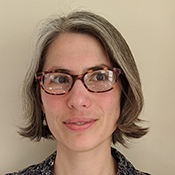
Katherine Hollander is a poet and historian. Her poetry, criticism, and scholarship have appeared in Literary Imagination, Pleiades, Hunger Mountain, Tupelo Quarterly, The Brecht Yearbook, New German Critique, and elsewhere. She is presently Faculty Fellow in modern European history at Colby College and a guest reader for Sugar House Review.