
Uncategorized
Johnny Horton
Two poems from Johnny Horton’s All That Seemed Clear
followed by a note on the author
Spirits
The Widow Lincoln communed with so many spirits
she had to be committed. To be haunted
is to be devoted. To paraphrase the secrets of the dead
you need a medium, a mirror in which you look
forward to appearances. Alcohol
comes from the Arabic word for “makeup.” Maybe
we have to change our looks
if we want communion. We have cocktails
because we can’t stop mixing. We love entertaining
possibilities. What we find intoxicating
we could fall for. What we fall for
makes us smart. Consider the German shepherd
barking at his reflection, the robin that sees in your pane
a blue sky for flying free. Socrates feared poetry
would make people think
their delusions could be true. Wile E. Coyote
shared his critical point-of-view
when he painted the mouth of a tunnel
he thought the Roadrunner could not run through. Maybe
we are innocent when we fall in love. We lose it
when we think we know what’s going on. Facades
are what we put up with
when we feel like hiding. The cover-up is how we live
with politicians. The unattractive Honest Abe
said he’d wear another face
if he had one. The vase our profiles make when we face off
must contain our thirst. We have to make out
if intoxication’s what we want.
Johnny Horton
Dear John Dillinger
We could rearrange our faces, shave our fingerprints, leave
our legends carved across the walls
that we escaped from. We still wouldn’t
find ourselves
motor-mouthing across the Silver Screen, translated
by Warner or MGM. I’m impressed, not by chilly nights
you spent in barns, regretting
all the hearts you’d broken, the one farm
you’d never return to, the fallow fields, clover
turning blushing cheeks to sunrise, but by the vanishing
act, how you disappeared in the North Woods
just to turn up in Arizona
as an alias, a carnival mask, bullets for teeth
and already gone. If everyone believes you’re someone
else, maybe you are
Humphrey Bogart. Maybe you’re James Cagney, born
to shout insults at the cops. Dear John,
I’d rather not think
the flashbulb’s powder pop
exposed Chicago concrete as your catafalque. I’d rather buy
the myth—how you burned those mortgages in the bank,
paid off so many failing farms. Things
might be easier then. I could pack
my bags, believe around the corner was a place, a station
where I could be another face.
Johnny Horton
Born on a nuclear submarine base in New England, and brought up on the south shore of Lake Michigan, Johnny Horton lives in Seattle where he teaches literature to veterans and walks dogs. He’s published poems in Poetry Northwest, Los Angeles Review, CutBank, Notre Dame Review, and City of the Big Shoulders: An Anthology of Chicago Poetry.
“Spirits” first appeared in City Arts Magazine; “Dear John Dillinger” first appeared in City of the Big Shoulders: An Anthology of Chicago Poetry.
Marsha Pomerantz
Two poems from Marsha Pomerantz’s The God’s Honest Truth
followed by a note on the author
Saint Luke Paints the Virgin
As soon as his brush lifted,
the elixir of her withdrew,
leaving her mud in small
shaped phrases. He was
painting his desire to hold
her always and want her
never. I’d trade always for
an apple, said the assistant,
stroking the arc of a cheek as
his teeth marked minutes along
his lips. Holiness is separation,
pooling just beyond depiction
in a single swimming thought.
That Luke could ever get her
down was either blasphemy
or fantasy, and both options
beckoned. Know me, he heard her say.
Take my likeness, make me likely.
Marsha Pomerantz
Fortune
Madame Maman at the kitchen
table, in turban and curlers,
reading the cards. Clucks and sighs
suggest my stint on earth gets grim.
She won’t say how or why. Am I to be
enticed by diamonds, beaten by clubs,
smothered by hearts, buried by spades?
You’re a goner, she says, but slaps down
fate upon fate, frowning after another
future. She never turns this one up:
that, following suit, I too will
tell stories from a blank deck.
Marsha Pomerantz
Marsha Pomerantz’s collection of poems, The Illustrated Edge, was published by Biblioasis in 2011; poems and essays have appeared in Beloit Poetry Journal, berfrois.com, Best American Essays 2016, Boston Review, broadsidedpress.org, Harvard Review, Literary Review, Parnassus, PN Review, Raritan, and Salamander. Selections and a statement of poetics are at poetrynet.org. The artist’s book They Run, made from her poem of that title by Claire Illouz (Chérence, France), appeared in 2016: www.claire-illouz.com. Her translations from the Hebrew include poetry and fiction.
“Saint Luke Paints the Virgin” first appeared in Raritan; “Fortune” first appeared in Salamander.
Chris Schlegel
Two poems from Chris Schlegel’s You Can Count on Me
followed by a note on the author
I Have Wasted My Life
I heard her introduce herself as Star
and once when working in an open garden
in East Oakland (folding soil into mason jars)
I met a grower named Gravity Gordon
who showed me furrows each for squash and yams,
told me at the fire her father ran a bar
past Martinez, raised dairy goats, and kept Mouflon rams.
We’d ridden side-by-side to Hermannplatz,
she in the Dutch manner, hair in a braid,
socks to the calf, skirt over shorts, the FAZ
in her busted orange DMK milk-crate
and sat the afternoon by the bocce court
as pensioners marked scores with savoy knots
(an extra turn in the line if the winners played one short).
Mara and I stood on President Street.
Workmen pulled down the summer scaffolding.
She touched me while still staring at her feet
and I pressed my lips to the blue bandana, holding
her head, telling her sorry, but I couldn’t.
The rise of the park’s near edge resembled wheat.
It wasn’t that I didn’t want. I did. I couldn’t.
Tim Fehr and I made Lake Champlain by nine …
his hooded eyes and yellow Sauconys …
we came to the campsite, hoping to swim again—
he rubbed more Echinacea on his knees,
Holly’s idea, the beachhead road obscured
by a narrow creamery, whose eglantine
rained down, eight years ago, on the painted wooden gourds.
Kalen knew Tim, and I Elizabeth—
we’d dropped, Kalen and I, Rob’s second badge,
so there we stood outside, straining for Death
and Chad Vangaalen’s voice beneath the sludge.
My father and my brother lost their jobs.
The arrow flew. The plover had its breath.
The bike was hers. The helmet and U-lock were Rob’s.
She’d wait on the concrete stairs to let me in …
I thought the saying went, “First gradually,
then all at once”—that it was Tennyson,
but she said Hemingway, and “suddenly,”
both being on her comps (onward to Honors).
She read Zukofsky to me, “A-11,”
making so little of it save for shape, “for honor.”
I shaved in the basement, walked to work at eight,
had lunch, copied the minutes, faxed the board.
Das weisse Band I caught on its closing night
and Ellen flipped the locks in her uncle’s Ford
after her shift, as June swept in twice over
by the D. & R., where Sean had launched his kite.
Under the lindens’ shade worms traced the tufts of clover.
Chris Schlegel
Sonatina in Beige
“One spits on the sublime, one lies in bed … ”
“Some days hell seems so very, very near … ”
Two years spent smoking languidly in bed,
hell and an undershirt. The shrub is near
but the scent—it hangs. Our Yorkshire lad keeps reading—
huddled in black—lonely—roommate in Reading
with his new girl, “Hi John, Till Sunday, Chris.”
So this is growing older—drinking a beer,
paying for two (what use in blaming Chris,
poet demi-maudit of bitter beer,
cowlick and lord.) He wants only to live,
to know beyond the borough where men live,
and what they do, and sometimes how they speak.
“Now comes the evening of the mind.” Go, speak.
Chris Schlegel
Born and raised in Berks County, Pennsylvania, Christian Schlegel is a doctoral student at Harvard; his first book, Honest James, was published by The Song Cave in 2015. He lives in Beacon, New York, with the poet Rachel Mannheimer.
Anna Scotti
Two poems from Anna Scotti’s Bewildered by All This Broken Sky
followed by a note on the author
Away
for Kathy
Crouching there, by the bald back tire,
you might be pulling roots from the black earth,
shooting craps, stirring the ashes of some archaic fire,
or tracing letters in the thickening soil, smelling leaves and bone
and loam rise against the swelling heat.
Your cheek is a wing, soft against the cool fender.
Last time: the shriek of crows, each blade of grass.
Now your fingers curl about a stiff cut hose, each separate
and determined to make this thing happen.
You released a falcon once, palms spread wide,
pushing him up, up into steep canyons of silvered clouds.
Your dogs will be snapping in the side yard, soon,
fearful and reluctant, but hunger-tamed
against the whispering uniforms, the jangled steel,
the deadening odor stirred by a thin breeze,
mingling with milkflowers, evanescent, and away.
Anna Scotti
Sheba
All that beauty never got me much; strangers laying claim to what they think they
recognize, every smile a promise, and most the kind you hope they won’t keep. Beauty’s
an old dog that’s too faithful, that sticks with you despite the curses and the kicks. They
say it’s a mask but it’s the opposite in fact; it reveals what’s inside, and everybody wants
that sweet cream at the center of a chocolate éclair. What am I, now, but an old broad
with glitter at her temples, scattered in her hair, yet I can’t stretch on the bus without
staking a claim. All that beauty never got me much but trouble, and a taste for trouble, a
folded note, a couple of drinks at the bar.
Anna Scotti
Anna Scotti is a writer, editor, and public speaker living in Burbank, California, where she teaches at a French international school. Scotti’s unpublished collection, Bewildered by All This Broken Sky, has been named finalist for the Bogan Prize, the Spacks Prize, and the CPR Editors’ Prize, with individual poems receiving a variety of distinctions including the Fischer Poetry Prize (Telluride Institute), the Pocotaligo Prize for Poetry, judged by Nikky Finney (Yemassee), and an honorable mention for the Neruda Poetry Prize, judged by Patricia Smith (Nimrod International Journal). Scotti’s poetry can be found in The New Yorker, Nimrod, Sequestrum, The New Guard Literary Review, The Comstock Review, Chautauqua, Fungi, and other journals. She also writes fiction; her work appears in recent and upcoming issues of Ellery Queen Mystery Magazine, and she has received the Orlando Prize for Short Fiction (AROHO). Scotti’s young adult novel, Big and Bad, will be published by The Texas Review Press in 2020. Read more at www.annakscotti.com.
“Sheba” first appeared in The New Yorker, December 18 & 25, 2017. “Away” was a finalist for the 46er prize and first appeared in The Adirondack Review, 2008-09.
Todd Smith
Two poems from Todd Smith’s The Weather Gods
followed by a note on the author
Strawberry Pickers, Nauvoo
Eleven thousand years ago the last
glacier scraped through this field.
Transmuted by the new sun, struck
dumb with fear. When Joseph Smith
fell laughing to his knees before a pillar
of fire, his tongue swelling, his father
descended and spoke in a voice as cold
as the risen Sangamon Creek, saying
go home. Past noon, this basin of dirt
riddled with thick bloodless cracks.
A crop duster buzzes low overhead
to cough its toxic rain like a blessing
toward the dark corduroy of soybeans
to the west. Paint huffers straighten
on knee pads cut from vulcanized tires
and their pink-stained hands slow for
half a beat. Through the propped back
door of the school bus, popular music
washes over them, saying nothing
they haven’t heard somewhere before.
Todd Smith
Souvenir
– for Elliot
“The body, monks, is not self…”
– Siddhartha Gautama
Past midnight our firstborn drops
the brittle cluster of oil noodles,
carried home in a violet backpack
from his high school trip to Beijing
with a skewer of fried scorpions
and this Chairman Mao snow globe,
into a saucepan barely wide enough
to hold it. Hot water bites his fingers
and he flinches, swears, and laughs.
The noodles boil, trying to untangle
from within. Years ago, when he
was to us a girl, we watched a robin
pluck dry fronds of pampas grass
from the ditches, shuttle them back
to an elbow under the rain gutter,
and trick each into its place, one
after another, with a reptilian logic
that requires nothing more. Soon
we are awake, on the overnight bus
between a construct and a memory,
holding both in arm’s reach. Soon
the robin, meticulous and gone.
Soon the fabricated snow. Soon
our selves, improbable, this life
and the few things in it the heart
keeps, and winds, and unwinds,
and will not hesitate to wind again.
Todd Smith
Born and raised in rural west-central Illinois, Todd Smith studied poetry, music, and math at the University of Virginia, and received his MFA from the Iowa Writers’ Workshop. His poems have appeared in Prairie Schooner, The Yale Review, Crazyhorse, River Styx, Green Mountains Review, Barrow Street, Palette Poetry, Verse Daily, and elsewhere. He received Frontier Poetry’s 2017 Award for New Poets, and was a semi-finalist in the 2018 92Y Discovery Poetry Contest. An actuary by profession, he lives in West Des Moines, Iowa with his partner, poet Heather Derr-Smith; their daughter; and their two sons.
“Strawberry Pickers, Nauvoo” first appeared in Prairie Schooner; “Souvenir” first appeared in Frontier Poetry.
Anne-Marie Thompson
Two poems from Anne-Marie Thompson’s Mama Calls Me Crying
followed by a note on the author
New Year’s Day
i.m. José Feghali
When I knot the fourth trash bag, my new flat screen says
another Polar Vortex. Last year’s Vortex trapped me two days
in an Oklahoma toll-road town with my ex. The Holiday Inn’s
broken fire alarm iced us out of our pretending and into
the brand new year’s white morning. José, I only knew you
from a distance, but somehow today I feel you listening. Today,
I’m making room for Christmas flat screens and stand mixers.
The screen says how many died from December drinking and then
from December weather. José, you died from December sadness
and then from a gunshot wound to the head. Great souls are always
mysteries. You would have tracked this Vortex with your antennaed Jeep,
would have heard a shift in the wind and known what was coming.
You could hear what others couldn’t, could make a piano sound
like silver-pure longing: more human than the human voice;
song before song existed. Last midnight at the silvery party, I met
a man in a spangled mask and said, This stranger will warm my hand
in his silver pocket for the whole Vortex, and then it was another year.
José, this is an elegy, because death is too small for a great soul.
This is all about pretending, about stepping into any other
weird hobby, or masquerade costume, or self. Like stepping into
the eye of a storm: everything suddenly still—only you, and then, music.
Anne-Marie Thompson
When I Tell You During Turbulence at 36,000 Feet That Everything Will Be Fine
I think of the man in the V for Vendetta mask
dangling his legs off the roof of a drugstore
on Franklin Street. No one else seemed to see.
My friends kept walking toward the restaurant,
talking about tax breaks and single payers,
and I told myself, advertising stunt, Halloween
prankster, my imagination, and then moved on
into the monochrome safety of evening.
We build our stories out of whatever we
can get our hands on. Ask any parent.
My dad never let go, so I never learned
to ride a bike. Now he collects castoff junk
during his jogs around the neighborhood—
baseball cap, porcelain Easter rabbit, Texas flag,
kitchenette—and keeps it all in a storage unit.
There’s a story here, somewhere inside
the jumbled, sun-bleached universe: Hold on,
you never know. Or maybe: Everything will be fine.
Anne-Marie Thompson
Anne-Marie Thompson works as a technical writer for a software company and lives in the San Francisco Bay Area with her family. She has taught writing and music courses at Johns Hopkins University, Westminster College, and Lincoln University. Her poetry collection, Audiation (Story Line, 2013), won the Donald Justice Award.
“New Year’s Day” first appeared in Poor Claudia; “When I Tell You During Turbulence at 36,000 Feet That Everything Will Be Fine” first appeared in Ploughshares.
Jonathan Weinert
Two poems from Jonathan Weinert’s A Slow Green Sleep
followed by a note on the author
Green Swoon
When we were dead, our vexed
tongues hung limp.
You’d made your done face, more or less,
and that was it.
We slept a slow green sleep.
And then the grass grew bronze and stiff
and all we knew was grass
and the ways through grass
and the small strange laws of sleep.
There the ferns grew like hair on the heads of the old dead.
The young dead ate their jam of fig and white cheese.
We wrote our odes and told our jokes
and laughed or rolled our hard white eyes.
You’d think we’d grow as tired of this as we had in life.
But when the weird bell called
and the halls of the dead were filled with the smells
of pine and moss, then how
we loved our deaths the more
and kept on in the ways of death
and left the chance of new life to the ones
who weren’t yet done with time.
We were. We’d get in bed there,
in the grass town of the dead,
left leg to right leg, sex to sex,
and let death flow from chest to chest,
a cold sweet air we had no need to breathe,
and hold it there in a deep green swoon
while the earth filled up with dust
and passed through an age of dust
on its way to the last days of dust.
Jonathan Weinert
2012
One hundred fifteen in the shade, all day. Burn holes
lace the rose leaves; tomatoes blacken on their stakes.
The citizens of Denver, Phoenix, Santa Fe,
pent inside their malls like spiders under glass,
refuse to read the mortal edicts of the heat.
The landscape bides its own destruction. In a pit,
some thousand bones of hominins and wildebeests
lie twinned together, casual and intimate,
beside the faintest tracing of a dried-up pool.
The same old news: the earth could shrug us lightly off.
Two thousand acres burn toward Colorado Springs.
We humans love the wrongest things: eternity,
our histories, our brains. Indifferent tides will crush
the cordillera in a million years, before
the whole thing ices up, erasing us. Love that.
Jonathan Weinert
Jonathan Weinert is the author of In the Mode of Disappearance, winner of the Nightboat Poetry Prize, and Thirteen Small Apostrophes, a chapbook. He is co-editor of Until Everything Is Continuous Again: American Poets on the Recent Work of W.S. Merwin. Jonathan contributed to Renga for Obama, a linked poem sponsored by Harvard Review in honor of the 44th president. He lives in Stow, Massachusetts, on the edge of Heath Hen Meadow.
Amie Whittemore
Two poems from Amie Whittemore’s Glove Without Winter
followed by a note on the author
Lunar Eclipse
Though I marked my calendar, I’ll forget to watch
earth paint the moon gray, then black, then white again.
White as toothache, dry elbow skin, a crown of bones,
as I imagine, a narwhal’s tusk, though I’ve never seen one.
Tonight, I’d dip that tusk in my wine glass
to prevent all future hangovers, all future gloomy
moods where I pretend I’ll look up the etymology
of melancholia but don’t. Where I pretend I need
a spouse to soothe me—but I don’t. Like—I won’t say
earth or moon—but like a shovel, I’m purposeful
but often idle. Collecting cobwebs is a passing,
though fulfilling hobby. Someday I hope to be less
shovel, more soil. Prepped for roots, for thriving—
Love, I want to say (to whom, I’m not sure),
I’ve come to a different power tonight.
This is the self stripped of alimonies, stripped of pearls.
Unforgiveable, unrelenting, cherished by no one—
not you, wife, nor you, husband. Not even you
dear moon, whom I want to see cloaked
but won’t. Clouds tonight. Bats beading them.
At least, I think so. Maybe smaller darknesses
are just that—smaller, and thus, personable.
Amie Whittemore
Starlicide
is safe for cats, owls, and creeks; for Laundromats, pedigrees,
and flutes; for windbags, soothsayers, and windshield wipers,
but not for crows or blackbirds, nor of course, for starlings,
who are aggressive, super-smart, and clever, who can nest
anywhere and sing Mozart’s allegrettos, whose plasticity
of behavior causes millions in damage to farms;
whose strengths annoy, whose strengths too closely shadow
those of European-Americans: also invasive, also bullying out
native populations; also in turns abrasive and charming,
so it makes sense some white scientists invented Starlicide
to starve the mirror of its brute mimicry.
They assure us Starlicide won’t enter the food chain
because it’s metabolized so fast you could say it flies
through starlings (and crows and blackbirds), plummeting
them to earth, upsetting all sorts of humans who once thought
bird crap on their cars nuisance enough. We’re assured
Starlicide has no known side effects aside from bird downpours
which, though problematic, won’t undercut the benefits
of less screeching and excrement, fewer flocks ravaging grain stores
before throwing themselves against sunset like intricate nets—
a habit particular to starlings but not crows and blackbirds
who pal around in smaller groups and thus can travel
together without swirling, an impossibility for starlings:
one wrong turn and they’ll break each other’s wings;
in that they’re like us too. Whenever a new batch
of Starlicide drops, crows and blackbirds whistle darkly
to their nestlings, warning them about humans,
even the girl leaving seeds on a pedestal for a crow
who thanks her with key chains, buttons, and paperclips;
wire and ribbon; bottle caps and dimes as if aware
of capitalism—an hypothesis scientists hope to prove
because, while animals shouldn’t be too much like us,
it’d be convenient if they understood give and take,
the cost of doing business, if they could see our economy
as we often do, propped like a carefully wrought nest
at the top of a tall tree, removed from the dust
and squalor below, so that it’s easy to forget it matters
what happens to the roots, that leaf and branch,
sun and soil, heart and feather, flesh and sound
fly or die together. Which the birds know.
They have wings and feet, eyes and brains, and this
worries some scientists, who have learned crows
cling to grudges and dive-bomb humans
who do them or their loved ones wrong, teaching
these grudges to each other, just like we do.
A falconer was hired after the last Starlicide panic,
after the sky again spewed dead birds like a foul omen,
spurring outliers to suggest we please try something else.
The local news is thrilled, smitten—a lady falconer!—
asking if she would please don a cape and long dress.
She wears her jeans and flannel and says no
comment before taking her bird below the roosting starlings
whose splintered chants seem to goad the falcon on—
as if they know fear is better than Starlicide, that poison
always ends up in the king’s chalice, their fragmented
symphony a prettier ‘fuck you’ than we deserve.
Amie Whittemore
Amie Whittemore is the author of the poetry collection Glass Harvest (Autumn House Press) and co-founder of the Charlottesville Reading Series in Virginia. Her poems have won multiple awards, including a Dorothy Sargent Rosenberg Prize, and have appeared in The Gettysburg Review, Sycamore Review, Smartish Pace, Cimarron Review, and elsewhere. She teaches English at Middle Tennessee State University.
“Lunar Eclipse” first appeared in Superstition Review; “Starlicide” first appeared in Edge Effects.
Editorial Assistant
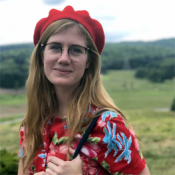
Kimberly Kemler lived in various Florida towns before moving to Tokyo to teach English as a second language. She now lives in Baltimore, and is an MFA candidate in poetry at Johns Hopkins University.
Editorial Assistant

 Jessica Hudgins grew up in Georgia and Florida and earned degrees from the University of Florida and Johns Hopkins University. Her poetry appears in The Journal, Portland Review, Glassworks and elsewhere. She lives in Baltimore and teaches creative writing in The Writing Seminars at Hopkins.